

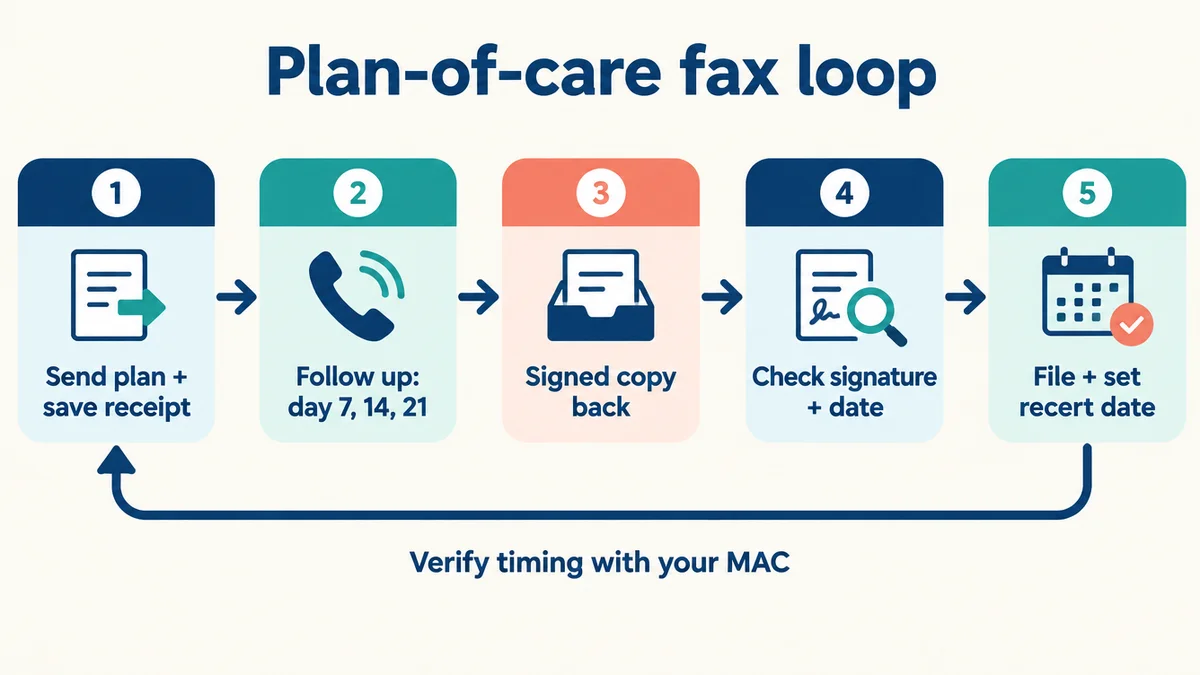
For a Medicare patient in outpatient PT, OT or speech therapy, fax the plan of care to the physician or NPP (nurse practitioner, physician assistant or clinical nurse specialist) as soon as the therapist writes it, keep the send record, and follow up on a fixed schedule until a signed and dated copy comes back. Under CMS's Medicare Benefit Policy Manual, initial certification is timely when the physician or NPP signs and dates it within 30 days of the first treatment, which includes the evaluation. Since January 1, 2025, there is also an exception when a signed order or referral is on file and you can show the plan was delivered to the physician or NPP within 30 days of the evaluation.
This article is general information, not legal, tax or compliance advice. Agency rules and fax numbers change, so confirm with the agency or a qualified professional before you send.
Certification timing and documentation rules come from CMS and are applied by your Medicare Administrative Contractor (MAC). MAC pages can word the same rule differently, and the rules have changed recently. Check your MAC's current outpatient therapy documentation page before you change how your clinic works. Other payers set their own rules.
Why the signature matters
For Medicare Part B outpatient therapy, the physician or NPP certifies the therapy plan of care. Without a certification for the billed dates, CMS's Benefit Policy Manual says the service "might be denied for lack of the required certification." It calls this a technical denial. The same section says a denial is overturned if an appropriate certification is produced later. For a supplier such as a therapist in private practice, the manual notes that a technical denial for missing certification can leave the patient liable. That is why it recommends telling patients about the certification requirement.
An unsigned plan does not automatically mean an unpaid visit. CMS allows delayed certification, covered below. But every path runs through the same thing: proof that the plan went to the physician or NPP, and proof of what came back.
The timelines to plan around
These are the federal timelines as of November 17, 2026, from 42 CFR 424.24(c) on eCFR, the Medicare Benefit Policy Manual chapter 15, §220.1.3, and CMS's MLN905365 booklet (September 2025).
Initial certification: 30 days, including the evaluation
The manual says timely certification of the initial plan is met when the physician or NPP certification is "documented, by signature or verbal order, and dated in the 30 days following the first day of treatment (including evaluation)." It also says the therapist should forward the plan as soon as it is established, and that "evidence of diligence in providing the plan to the physician" may be considered if certification is delayed.
Verbal orders: signature within 14 days
If the physician or NPP certifies by verbal order, the manual says it "must be followed within 14 days by a signature to be timely," with a dated note of the order in the patient's record.
Recertification: at least every 90 days
The regulation requires recertification at least every 90 days. The manual adds that recertification should be signed when the need for a significant change to the plan becomes evident, or at least every 90 days after treatment starts under that plan. A physician or NPP can certify a plan for less than 90 days, and treatment past the certified duration needs a recertification.
The order-or-referral exception (since January 1, 2025)
CMS finalized this in the CY 2025 Physician Fee Schedule, and it is now in 42 CFR 424.24(c)(5). For a plan established by a therapist, the physician or NPP signature on the initial plan is not required when two things are in the record:
- a written order or referral from the patient's physician or NPP, and
- documented evidence that the plan of treatment was delivered to that physician or NPP within 30 days of completing the initial evaluation.
CMS's MLN905365 booklet says the order or referral must be signed and dated, identify the physician or NPP and the patient, and indicate the type of therapy. It also says the exception does not apply to recertifications or to plans in a comprehensive outpatient rehabilitation facility (CORF). Without an order or referral on file, you still need the signature.
For a fax routine, this makes the send record matter. A sent fax with a delivery receipt is one record of when the plan went out and to which number. Whether it is enough evidence for your claims is your MAC's call. Ask them, and keep whatever they ask for.
Delayed certification
The manual says delayed certification is deemed satisfied when the physician or NPP certifies at a later date with a reason for the delay. Certifications are acceptable without justification for 30 days after they are due. Examples of reasons include a physician who did not sign or an original that was lost. For long delays (over 6 months), the manual lists supporting records such as orders, progress notes, telephone contact and requests for certification. Your fax log of requests is that kind of record.
What changed in the latest fee schedules
As of November 17, 2026, the last change to 42 CFR 424.24 shown on eCFR took effect January 1, 2025 (the exception above). CMS published the CY 2027 Physician Fee Schedule final rule (CMS-1848-F) in the Federal Register on November 9, 2026, effective January 1, 2027. Its regulation text amends other sections of part 424 but not §424.24. Check your MAC's guidance for any therapy documentation updates that follow it.
Send the plan once, cleanly
Before the first send:
- Confirm the fax number with the physician's office if you have not sent to it before.
- Check the file page by page. It should be readable, upright, complete and in order, with the therapist's signature and date on the plan. See how to prepare a document so it faxes cleanly. A file can be up to 50 MB, measured after it is converted to fax quality, and up to 350 pages; a file over the limit is rejected automatically.
- Add a cover page with the patient identifier the office uses, what you need ("signature and date on page 3"), a return-by date, your clinic's receive number and a callback name.
- Send once. Wait for the final status. Delivered means the transmission completed. It does not mean anyone signed. If it fails, read why a fax fails to connect before resending.
- Save the receipt. On the web dashboard, open the fax on the Sent Faxes page and choose Download Receipt (in the app, tap the delivered fax). It lists the destination number, page count, and when the fax was sent and completed. File it with the chart or log it where your MAC expects to see evidence.
A follow-up schedule
Count from the first treatment day (the evaluation). A schedule many clinics can live with:
| Day | Action |
|---|---|
| 0 | Evaluation; plan written; fax sent; receipt saved; log updated |
| 7 | Not back? Call the physician's office. Confirm they received it and who signs |
| 14 | Still not back? Re-send with "second request" on the cover page. If the physician gave a verbal order, check that its signature is due within 14 days of the order |
| 21 | Call again. Note the name of the person you spoke with |
| 30 | Initial certification window closes. If unsigned, follow your MAC's delayed-certification guidance and keep every request on file |
Log every call and every send with the date. Those notes are what the delayed-certification and exception rules ask you to be able to show.
When the signed copy comes back
- Match it to the right patient and plan (date of the plan, not just the name).
- Check that there is a signature and a date, and that the duration certified matches the plan or note any change the physician made.
- File it in the chart.
- Update the tracker: signed date, certified-through date, recert due date.
Signed plans tend to come back when the physician's office gets to its paperwork, often after your clinic closes. This is where FaxDash Connect fits if your clinic still files paper. FaxDash's Connect help says each new fax prints once, so run it on one front-desk computer. If that computer is off overnight, faxes that arrived print the next time Connect starts, so leave Start at login checked. On a team, it prints the shared inbox, and the sent history shows who sent each request. Whoever opens up matches the signed plans to the tracker first. Place that printer where only staff can see the tray.
Recert calendar you can copy
Use your EMR if it tracks this. If not, a shared spreadsheet works. Many clinics use a patient ID or chart number on shared sheets.
Patient ID | Payer | Order/referral on file (Y/N) | Eval / first treatment date | Plan sent (date, receipt saved Y/N) | Follow-ups (dates) | Signed and dated (date) | Certified through | Recert due (90 days or end of plan, whichever first) | NotesFaxDash does not track certification dates. The tracker lives in your EMR or spreadsheet. FaxDash handles the sending, receiving and receipts.
Safeguards when faxing to physician offices
This section needs care, so it stays short. For the fuller version, read faxing patient information in a small practice.
- HHS FAQ 482 says covered providers may share patient information for treatment by fax with reasonable safeguards, and gives confirming a fax number that is not regularly used as an example.
- Send only the pages the physician needs to certify the plan. A short fax is easier for their office to review and sign.
- The same FAQ gives pre-programming frequently used numbers as another example safeguard.
- A FaxDash BAA is available on the Business plan only, requested through FaxDash support at support@faxdash.io or hipaa@faxdash.io.
- FaxDash's AI analysis (the summary, category and extracted details on received faxes) is on unless you turn it off. FaxDash's receiving help says accounts with a signed BAA start with it off and can turn it on, and that "Analysis runs on Amazon Bedrock, inside our AWS BAA." Without a BAA, you can turn off "Summarize received faxes with AI" in Settings before signed plans start coming back. Turning it off does not by itself make your fax workflow HIPAA compliant.
FAQ
Can the physician sign electronically? The manual leaves the format of certifications, and how you obtain them, to the facility or practitioner, and it accepts a dated signature on the plan or "some other document that indicates approval." Whether a given electronic signature meets your MAC's signature rules is a question for your MAC.
What if the physician never sends it back? Keep following up on your schedule and log each attempt. If the patient was referred with a written order or referral, check whether the 2025 exception applies to the initial certification and what evidence your MAC expects. If not, follow your MAC's delayed-certification guidance. Noridian (JE Part B), for example, lists "proof of attempts if the required physician certification statement could not be obtained" among the records it may request.
Does the exception remove the need to chase recertifications? No. CMS's MLN905365 says the exception does not apply to recertifications.
Does a Delivered fax prove the physician received the plan? Delivered means the transmission completed to the number you dialed. Your MAC decides what counts as evidence that the plan was delivered. Keep the receipt and your call notes together.
Does this apply to my commercial payers? Not necessarily. These are Medicare rules. Check each payer's policy.
Start the tracker today
Copy the recert calendar above into your EMR or a shared sheet before your next Medicare evaluation. On a FaxDash team, signed plans land in one shared inbox and the sent history shows who sent each request. To try sending first, FaxDash offers 2 free pages when you sign up.
Sources checked November 17, 2026: 42 CFR 424.24 on eCFR (up to date as of November 16, 2026); Medicare Benefit Policy Manual chapter 15, §220.1.3 (chapter Rev. 13889, issued 07-30-26); CMS MLN905365 (September 2025); CMS-1848-F, the CY 2027 Physician Fee Schedule final rule (Federal Register, November 9, 2026); Noridian JE Part B outpatient therapy documentation page; HHS HIPAA FAQ 482; FaxDash Help.