
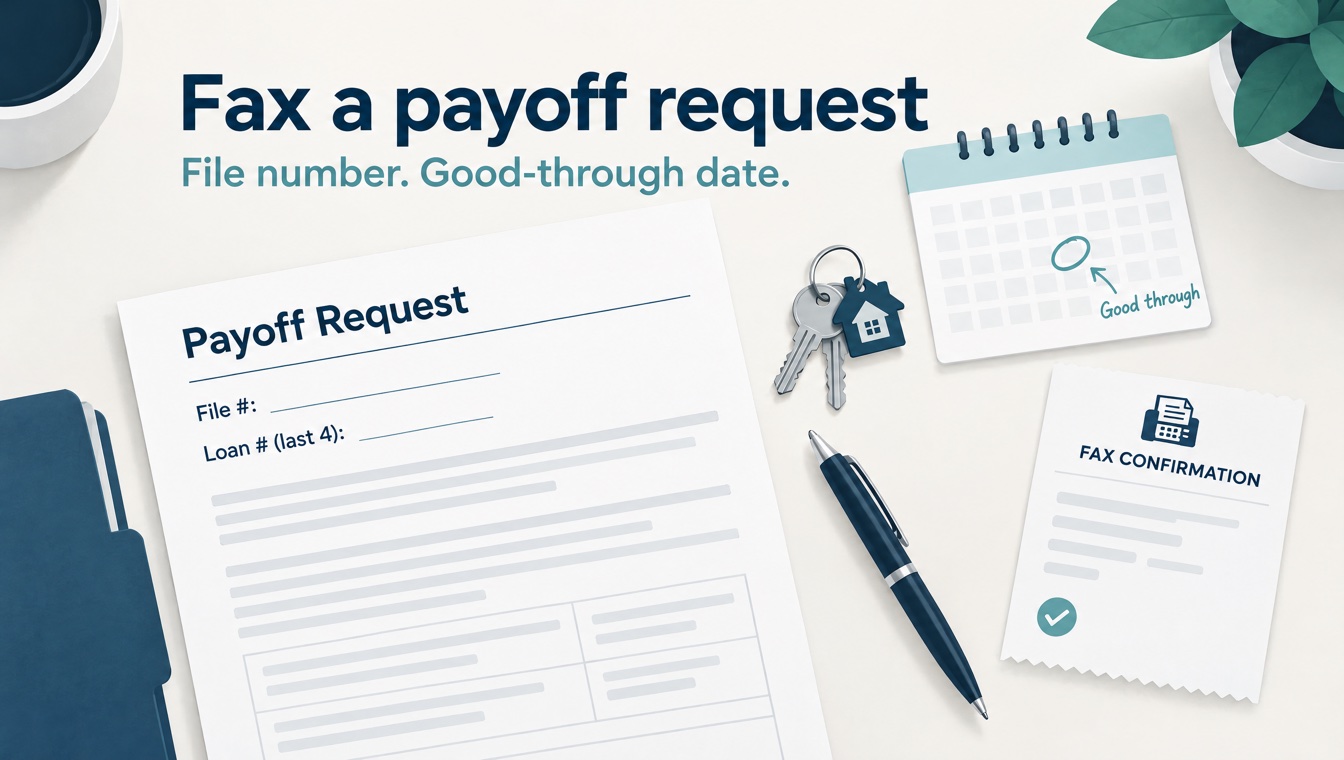
The short answer
A payoff request asks the lender or servicer for the exact amount needed to pay off a loan as of a certain date. Title and escrow offices often send it by fax. Fax it to the payoff number the servicer publishes or confirms by phone, with a cover sheet that shows your escrow or file number, the property address, the borrower's name, the last four digits of the loan number, and the good-through date you need. Include the borrower's signed authorization if the servicer requires one.
Our free title and escrow payoff request cover sheet has those fields. You can fill it in online and download a PDF.
This guide describes the paperwork. It is not legal advice.
What the rules say about payoff statements
For a consumer loan secured by the borrower's home, Regulation Z requires the creditor or servicer to send an accurate payoff statement within a reasonable time, and generally no later than seven business days after it receives a written request from the consumer or someone acting for the consumer. There are exceptions, for example for loans in bankruptcy or foreclosure, reverse mortgages and some disasters. The text is in 12 CFR 1026.36(c)(3) on the CFPB's site.
Two practical points follow from that:
- The request should be in writing. A fax is a written request with a timestamped record, which is one reason title offices still use it.
- The clock starts when the servicer receives it. Send early, and send it to the right place.
Find the right fax number
Servicers usually have a dedicated payoff department, and its fax line is not the same as general customer service. Good sources are:
- The servicer's own website or a recent mortgage statement
- A phone call to the servicer's published customer service number, asking for the payoff department's fax
- Your office's own record of a number you have confirmed recently with that servicer
Do not use a fax number from an email you were not expecting, or from a document a third party sent you, without checking it against one of the sources above.
What to put on the cover sheet
- To and company. The payoff department and the servicer's name.
- Fax. The payoff fax number you confirmed.
- From and phone. Your name, your title or escrow company, and a direct phone number.
- Date and pages. Count every page, including the cover.
- Escrow or file number. Your office's file number, so the payoff comes back to the right file.
- Property. The property address.
- Borrower. The borrower's name as it appears on the loan.
- Loan number (last 4). Only the last four digits on the cover sheet.
- Good through. The date you need the payoff figure to be good through, usually your expected closing or funding date with a few days of margin.
- Message. What is enclosed and how to send the payoff back, for example "Signed borrower authorization enclosed. Please fax payoff to the number above."
If the servicer's own request form needs the full loan number, write it on that form. Keep the cover sheet to the last four digits.
How to send it
- Gather the pages. Cover sheet, the borrower's signed authorization if the servicer requires it, and the servicer's request form if it has one.
- Check the scan. Signatures and loan numbers must be readable at fax resolution. Our guide to preparing a document to fax cleanly has tips.
- Send once to the confirmed number. Any fax service works. FaxDash gives each send a status and a record, which helps when several people work the same file.
- Note the send in your file: date, time, number, and page count.
If the fax will not connect, see what to do when a fax fails to connect.
After you send
A Delivered status means the fax transmission completed. It does not mean the payoff department has opened the request or will meet your date. If you have not received the payoff in the time you expect, call the servicer and ask whether the request was received and whether anything is missing.
How FaxDash compares for requesting and receiving a payoff
A send-only purchase will not give the servicer a return fax number. For a hypothetical three-person office sending 100 pages to U.S. numbers and receiving 100 pages a month, compare the reply path as well as the outgoing request. We make FaxDash; provider documentation checked November 7, 2026.
| Service | Pages and receiving | What the next person can check |
|---|---|---|
| FaxDash Business | Dedicated number; 500 received pages and 60 send credits monthly. This example needs 40 additional send credits | Individual logins, shared inbox and sent history, with sender attribution. See pricing and teams |
| Fax.Plus Business | Two numbers and 1,000 monthly pages. Assigning the same number to three members counts each incoming page three times | Shared Sent history needs support activation; queued Outbox items remain sender-only. See plans and team-number setup |
| eFax Business | One number, five user licenses and 500 monthly pages | Searchable storage is listed; verify the team's shared-view permissions before buying. See plans |
| MyFax Home Office | One account with 100 sent and 100 received pages, separate allowances | Searchable archive; Share With 5 means email sharing, not five verified independent seats. See plans |
Our advice: Fax.Plus or eFax may suit an office wanting more included user licenses. MyFax can fit email-based handling, but check whether that gives your office enough accountability. Whichever you choose, save the request, transmission record and returned payoff in the transaction file. A delivery receipt does not validate the payoff figures or wire instructions. Features and allowances can change.
When the payoff comes back
Treat the wiring instructions on a payoff statement as something to verify, not something to trust because it arrived. Real estate closings are a common target for fraud that swaps in a criminal's bank account. The CFPB's guidance on mortgage closing scams recommends confirming payment details by phone with a number you already know, never one taken from the message itself.
Before you wire:
- Call the servicer at an independently confirmed number and verify the account details on the payoff
- Check that the good-through date covers your funding date, and that any per-diem interest is reflected
- Recheck if anything about the payoff changes after you first verify it
Our wire payoff instructions verification checklist covers this step in detail. If you suspect fraud, the CFPB advises contacting the sending bank right away and reporting it to the FBI's Internet Crime Complaint Center.
Checklist
- Payoff fax number confirmed from the servicer's own source
- Escrow or file number, property and borrower filled in
- Loan number (last 4) only on the cover sheet
- Good-through date allows for funding delays
- Signed borrower authorization included if required
- Sent once; send logged in the file
- Wire instructions on the payoff verified by phone before funding
Get the cover sheet
Download the title and escrow payoff request cover sheet as a print or fillable PDF, or fill it in online.
This guide is general information, not legal or tax advice. Fax numbers, forms and agency rules change, so check the agency's official page before you send. FaxDash isn't responsible for decisions made or actions taken based on this guide. For advice about your situation, talk to a qualified tax professional or attorney.